Cracked Haven — Why You Should Avoid Cracked Software

Let’s be honest: most of us have used pirated software at some point. The appeal is obvious — an expensive product, free. The risk is much less obvious, and that is exactly the problem. A cracked binary has, by definition, been modified by a stranger. Once someone is already patching machine code inside a program you have chosen to install and run with your own privileges, there is nothing technical stopping them from patching in something else as well.
This post does two things. First, the defensive half: how to use binary patch diffing to verify what a crack actually changed — a genuinely useful skill for anyone who needs to establish whether a binary has been tampered with. Second, the demonstration: taking the clean binary and showing how little effort it takes to hide arbitrary code inside it, so the risk stops being abstract.
The subject is a cracked Adobe Photoshop CS6 obtained from a piracy site — one I had personally used for years before moving into security, and which I decided to go back and audit.
Prerequisites: this write-up assumes background in reverse engineering, x86-64 assembly, Windows APIs, disassemblers such as IDA, and basic binary patching / patch diffing.
⚠️ Disclaimer: this is for educational purposes only. I do not support piracy in any form. The goal is awareness — showing why cracked software is unsafe and how its integrity can be checked. Anything you do is your own responsibility.
⚠️ Note: This is a re-write by AI, but have been vetted by Author.
📄 The original report is also available as a PDF. The demonstration binary and supporting files are in the GitHub repository.
Key takeaways
| # | Takeaway |
|---|---|
| 1 | A crack is an unaudited binary patch written by an anonymous author, running with your privileges. Trust is entirely misplaced by default. |
| 2 | Binary patch diffing can verify it. Comparing the official and cracked binaries with BinDiff reveals exactly which functions changed — and therefore whether anything beyond the licence bypass was added. |
| 3 | This particular crack was clean — only two functions differed, both purely licence-check bypasses. Reassuring, but that was luck, not a guarantee. |
| 4 | Adding hidden code is trivial. Using only IDA Freeware and a hex editor, arbitrary API calls can be patched into the same binary. |
| 5 | The demo used MessageBox; it could just as easily have been ShellExecute or WinExec — downloading and running a payload every time the application launches. |
| 6 | Verification is the only defence if you insist on running untrusted binaries — and the real answer is to use legitimate software. |
Part 1 — Verifying the crack: binary patch diffing
In Photoshop CS6, amtlib.dll is the library responsible for licence validation. Cracking
Photoshop amounts to replacing that one library. The question worth asking is: what else did
the replacement change?
The approach comes straight from vulnerability research — the same root-cause-analysis workflow
used to compare a patched and unpatched binary to locate a fix. Here the comparison is between
the official amtlib.dll and the cracked amtlib.dll, using IDA with the
BinDiff plugin by zynamics. (IDA Pro is expensive; IDA Freeware is sufficient for all
of this, and is what was used.)
The result is reassuringly small — only two functions differ:
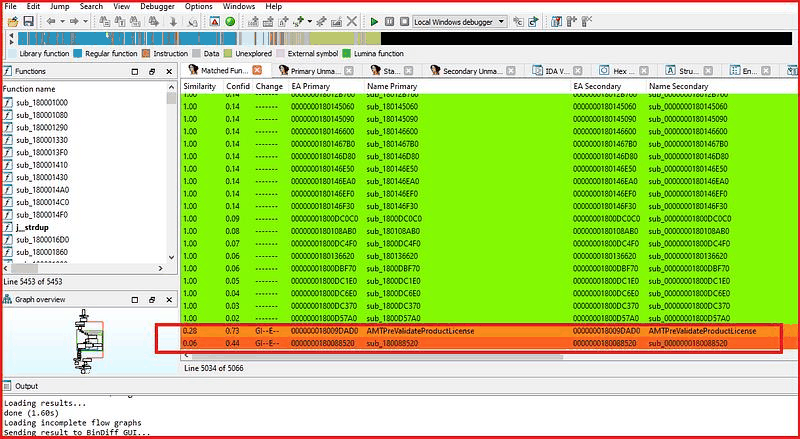
That immediately bounds the problem. Whatever this crack does, it does it in two places, and both can be read in full.
Changed function 1 — always return 1
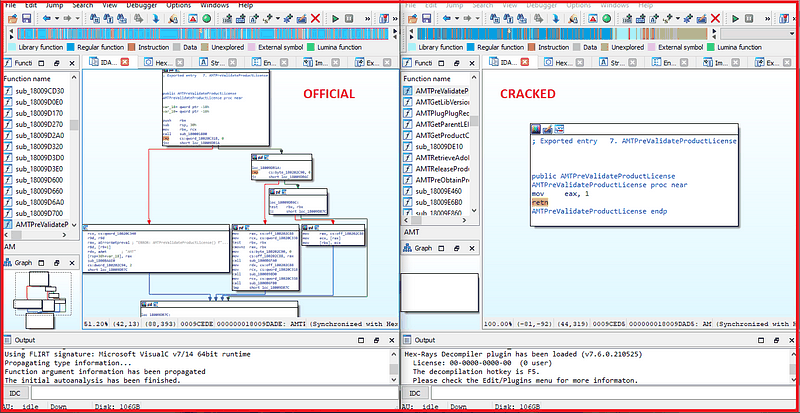
The official version shows a control flow graph with a series of blocks executing after various condition checks — the actual licence validation logic. The cracked version replaces all of it with a trivial stub that always returns 1. No licences are validated.
Changed function 2 — always return 0
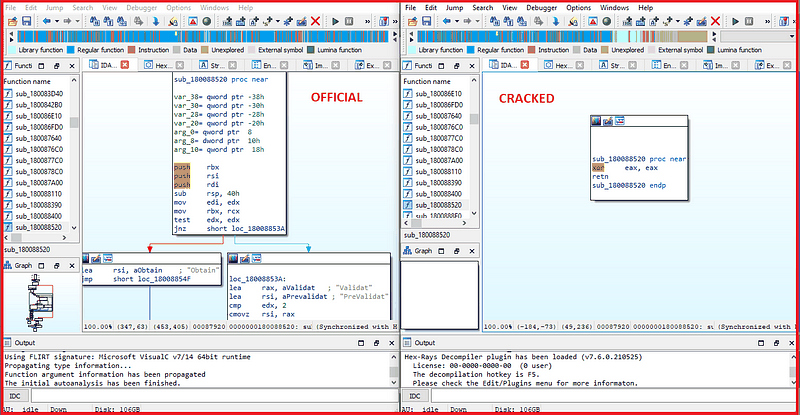
Similarly, the second function always returns 0 without checking anything. This looks like a pre-condition gate: the first function only runs its validation path if this one returns 0, so the crack forces that branch.
The verdict
This crack was clean. Two functions, both pure licence bypasses, no additional code. The software I had been using for years had not been backdoored.
But note what that conclusion rests on: I had to check. Nothing about downloading the file told me that. A different crack, from a different uploader, could have contained anything — and binary patch diffing is how you would find out. That is the transferable skill here.
Part 2 — Demonstrating the risk
Knowing exactly which two functions the crack modifies, the next step is to show how easily a cracker could have gone further. I took the official, benign binary, applied the same crack — and added something extra.
The two functions to patch:
AMTPreValidateProductLicense
sub_180088520
Patching the simple one
sub_180088520 just needs to return 0. IDA Freeware’s built-in assembler is limited (it is
restricted to IBM PC instructions, and better patching tools exist), but for this it is enough:
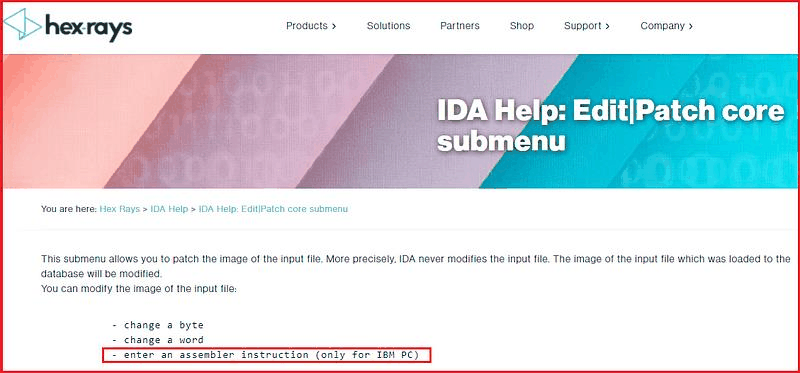
The return value always lives in rax (or eax for 32-bit). Assembling xor eax, eax sets it
to zero — anything XORed with itself is zero — and ret hands control back:
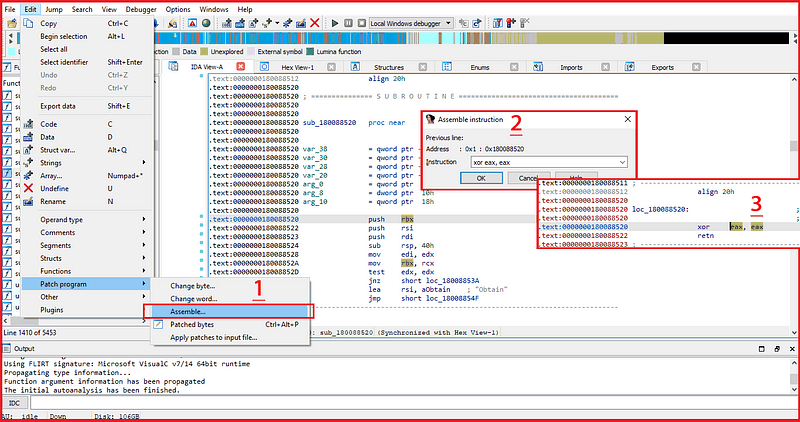
Going further: injecting an API call
The first function could be finished just as quickly — move 1 into eax and return. Instead,
this is where the demonstration begins. Reviewing the binary’s imports showed a MessageBox
import already present, so no new import table entry was even needed.
Calling an existing import by patching requires:
- Knowing the address of the API import
- Calculating the offset for the call
- Pushing all parameters onto the stack frame
- Keeping pushes and pops balanced so the stack frame is not corrupted
- Calculating offsets for string parameters
- Computing opcodes, since bytes must be edited directly
For step 6 there is a shortcut instead of hand-assembling: write the equivalent code in Visual Studio, disassemble it, and read the opcodes off the debugger (for anything complex, MASM works too):
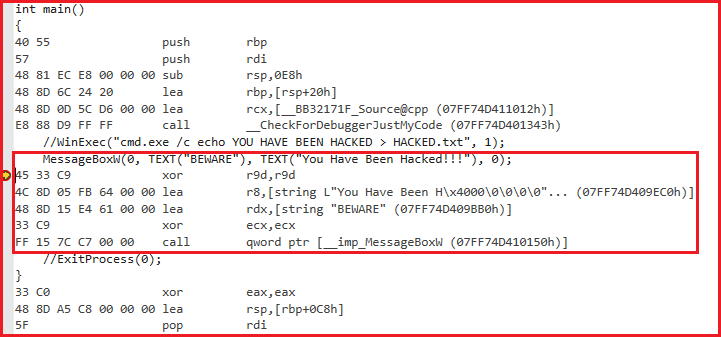
IDA’s live mapping between instructions and hex makes applying them straightforward — click an instruction in IDA View, switch to Hex View, and the corresponding bytes are highlighted ready to edit:
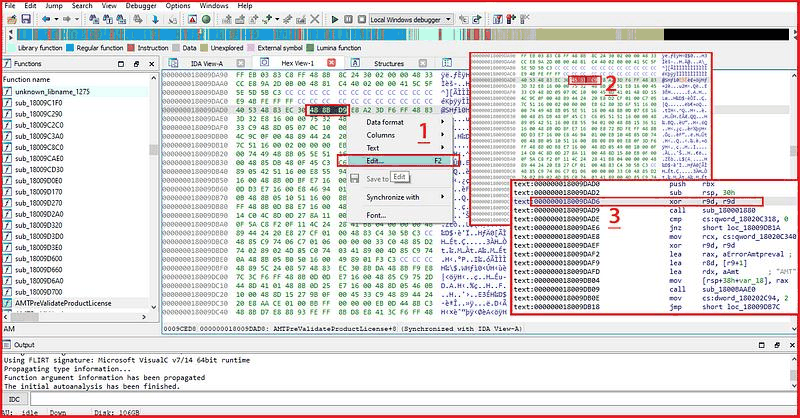
Creating string parameters
MessageBox needs strings. Since there is no compiler to allocate them, they go into unused
buffer space in the data section — find empty bytes, edit them to the desired string, and
define them as string literals (ALT + A in IDA).
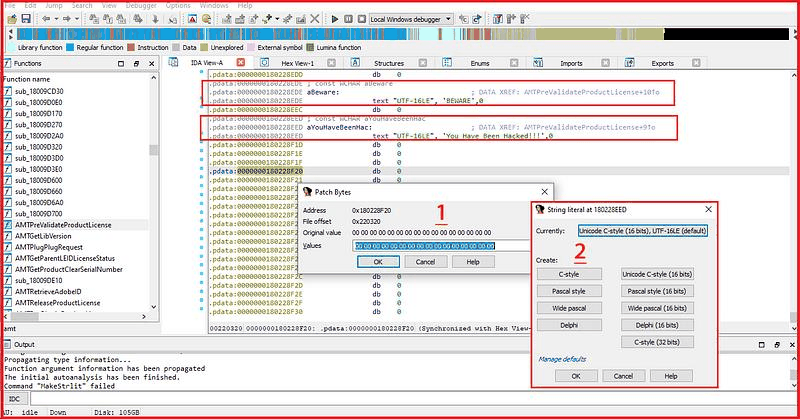
Two variables were created: the message body and the caption. One important detail —
MessageBoxW takes wide strings, so the variables must be defined as UTF-16 rather than
8-bit ASCII.
Calculating offsets
Loading those addresses into the parameter registers needs relative offsets, which follow a simple formula:
offset = callee_address - caller_address - instruction_size
Worked through for the message text:
| Value | |
|---|---|
callee_address (string) |
180228EED |
caller_address (instruction) |
18009DAD9 |
instruction_size |
7 |
| offset | 18B40D |
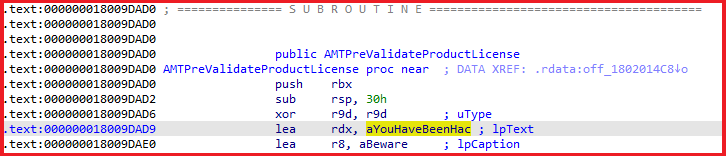
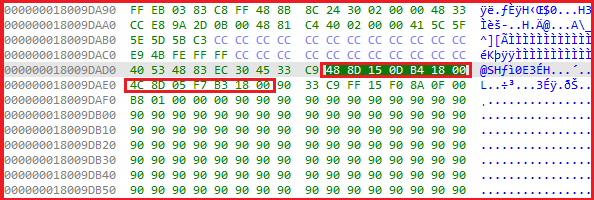
From the Visual Studio opcodes, lea begins 48 8D, 15 selects the destination register, and
the remainder is the offset in little-endian. The complete instruction becomes:
lea rdx, offset:text → 48 8D 15 0D B4 18 00
The remaining parameter is 0 — another xor — and the final step is the call itself. Same
method: compute the offset (0F8AF0), combine with the call opcode FF 15:
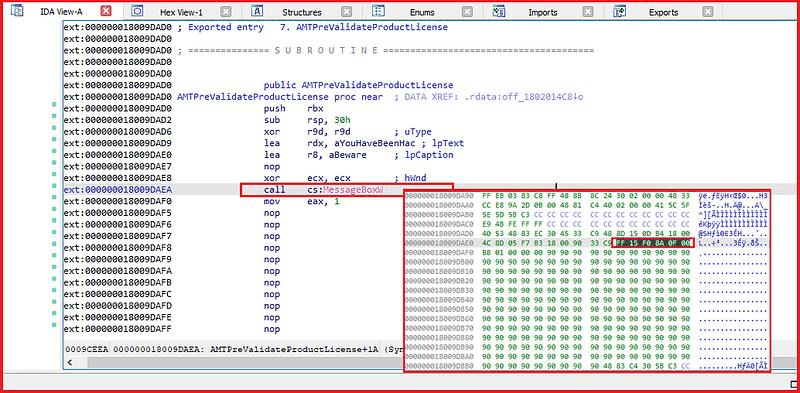
Every other instruction in the function was replaced with NOP, and the crack itself —
return 1 — appended. Applying the patch from IDA’s edit menu and dropping the result in place of
the official binary completes it.
The result
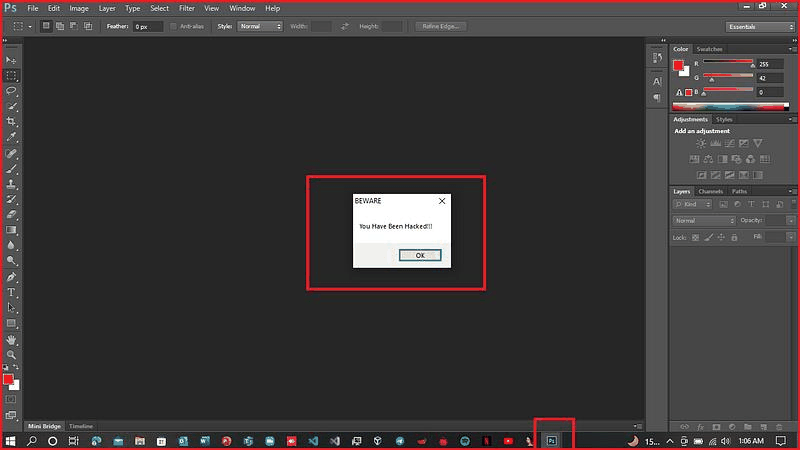
Photoshop now pops a message box on every launch: “Beware, You have been hacked !!!”
That message box is harmless. That is the entire point — it is a placeholder. The same
handful of patched instructions could have called ShellExecute, WinExec, or any
process-creation API. A single parameter change turns the demonstration into a downloader that
fetches and runs a payload every time the application starts, with no visible indication to
the user.
A short capture of the running result is in the repository as
Assets/Cracked.gif.

What this means in practice
For individuals:
- Cracked software is not free — the price is trusting an anonymous author with code execution on your machine, every time you open the application.
- Backdoored cracks are effectively invisible from the user’s side. There is no prompt, no error, nothing to notice. The application simply works as expected.
- Cracks are a known commodity malware distribution channel precisely because the victim installs them voluntarily, often disabling AV to do so — because cracks trip detections legitimately, users are conditioned to click through the warnings.
For defenders:
- Treat any cracked or unlicensed software on a managed endpoint as an unverified binary with arbitrary code execution, and respond accordingly.
- Watch for the enabling behaviours rather than the crack itself: AV exclusions added for a
download folder, real-time protection disabled shortly before an install, or an application
DLL replaced in
Program Filesoutside of a vendor update. - If you must assess a suspect binary, patch diffing against a known-good vendor copy is the fastest way to bound what changed — as demonstrated above, it can reduce the question to reading two functions.
The honest conclusion: verification is a mitigation, not a solution. Most users cannot reverse engineer a DLL, and even a clean crack today can be replaced by a backdoored one in the next release. Use legitimate software from the vendor.
Tools used
- IDA Freeware — disassembly, hex editing and binary patching
- BinDiff by zynamics — binary patch diffing
- Visual Studio — generating reference opcodes from compiled C
- MASM — for hand-assembling anything more complex
Repository contents
The recreated demonstration binary is in
tools_and_scripts,
archived with the password in the same folder. To reproduce the demonstration, rename it to
amtlib.dll and place it in a Photoshop CS6 directory in an isolated test VM.
⚠️ This binary deliberately executes injected code on launch. It is an awareness demonstration, not a tool — run it only in a disposable VM, never on a machine you care about. See SECURITY.md.
Disclaimer
The intended purpose of this exercise is solely to spread awareness so people avoid cracked software — because nothing is free. If something is free, then you are the product.
Artifacts in this repository must be used for educational purposes only.